
This fiber cement soffit panel delivers 6.9 square inches of net free vent area per lineal foot with a Class A fire rating and 30-year warranty. The panels withstand hurricane-force winds while preventing moisture, condensation, and mold buildup in attics. For Montana contractors dealing with wildfire risk and extreme weather swings, the non-combustible fiber cement composition resists rot, decay, and maintains dimensional stability without warping, splitting, or cracking.
Worth it for contractors who need precise ventilation calculations for code compliance. The 6.9 square inches per lineal foot meets IBC Section 1203 requirements for 1 square foot of ventilation per 300 square feet of attic floor area. At 1/4 inch thick by 24 inches wide by 12 feet long, these panels cover significant area while providing measured airflow that actually prevents attic moisture problems.

Fire Safety and Installation Specs
The Class A fire rating and WUI compliance (CalFire listing 8170-2180:0502) make these panels suitable for Montana’s wildfire-prone zones. Testing shows a flame spread index of 0 and smoke developed index of 5 or less per ASTM E84 standards. That’s not marketing fluff — it’s measurable fire resistance that matters when building in the wildland-urban interface.
| Specification | Value |
|---|---|
| Thickness | 1/4 inch (0.25 in) |
| Width | 24 inches (610 mm) |
| Length | 12 feet (3657 mm) |
| Net Free Vent Area | 6.9 sq in per lineal foot |
| Weight | Approximately 1.9 lbs per square foot |
| Flame Spread Index | 0 |
| Smoke Developed Index | ≤ 5 |
Installation demands 6d or 8d galvanized or stainless steel nails with minimum 1/4-inch head diameter, fastened every 12 inches on center along both front and back edges. Position fasteners 3/4 inch from side edges, 3/8 inch from butt joints, and 2 inches from corners. Install perpendicular to structural framing spaced maximum 24 inches on center. Maintain 1/4 inch clearance between the bottom of the panel and horizontal flashing.
Weather Performance and Practical Trade-offs
The fiber cement construction resists hurricane-force winds — relevant for Montana’s chinook wind events and mountain gusts. Unlike wood products, these panels maintain dimensional stability without warping, splitting, or cracking through freeze-thaw cycles. The material naturally resists wood-boring insects and termites, though termites aren’t the primary concern in Montana like carpenter ants are.
The panels come primed and ready for paint or pre-finished in 22 solid colors through Allura’s ColorMax system. Paint adhesion on fiber cement outlasts wood substrates, meaning fewer callbacks for peeling paint on soffits.
The main trade-off is weight — fiber cement panels are heavier than vinyl or aluminum options. That means more labor to haul and position, especially on tall installations. Proper handling prevents cracking or damage during installation. But for projects where fire resistance and measured ventilation matter more than installation ease, the weight penalty pays off in performance.


FAQ
What certifications does this product have for wildfire zones? The panels carry Class A fire rating for non-combustible materials and WUI compliance with CalFire listing 8170-2180:0502. Additional certifications include ICC-ES Approved (CERus-1012), Florida Building Code Approved, Miami-Dade County Notice of Acceptance, and Texas Department of Insurance Report.
How much ventilation do these panels actually provide? Each panel delivers 6.9 square inches of net free vent area per lineal foot based on the 24-inch width. This meets IBC Section 1203 requirements for 1 square foot of ventilation per 300 square feet of attic floor area.
What warranty coverage comes with these panels? Allura provides a 30-year limited warranty that’s transferable and covers manufacturing defects. This compares to wood soffits that typically last 5-10 years without extensive upkeep.
Can these panels handle Montana’s freeze-thaw cycles? The fiber cement composition maintains dimensional stability and does not warp, split, or crack. The material is engineered to resist rot and decay, making it suitable for moisture exposure during spring thaws.
Ready to Get Started?
Our siding specialists can help you find the right Allura products for your project.
More from Allura


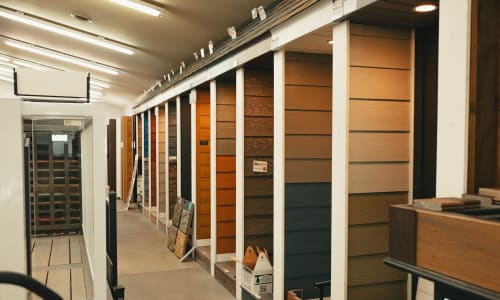
Explore All Allura Products
We carry Allura across all 11 Montana and Idaho stores.