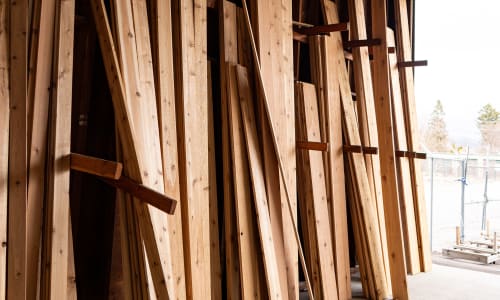
Nova Ipe 2x2 balusters deliver the hardest wood surface on the market at 3,680 lbf Janka hardness — that’s harder than most rocks contractors pull out of Montana clay. These Brazilian hardwood posts last 75+ years without chemical treatments, carry a Class A fire rating (equivalent to steel and concrete), and shrug off everything from grizzly claws to hailstones the size of golf balls.
The balusters target high-end residential deck projects where material failure isn’t an option. At 1.375” x 1.375” actual dimensions, they’re milled for modern railing codes while delivering the density that makes Ipe legendary. For Montana contractors building in wildfire zones or dealing with clients who expect their deck to outlast their mortgage, these balusters solve durability problems composite can’t touch.

Extreme Durability That Justifies the Price Tag
The numbers tell the story. 3,680 lbf Janka hardness puts these balusters at roughly 18 times harder than typical composite decking materials. Modulus of rupture hits 25,400 psi with modulus of elasticity at 3,140 x 10³ psi — engineering speak for “this wood doesn’t break.” The 25-year warranty undersells the reality. Field experience shows properly installed Ipe lasting three times that long.
| Specification | Value | Source |
|---|---|---|
| Janka Hardness | 3,680 lbf | manufacturer |
| Density | 69-70 lb/ft³ | manufacturer |
| Service Life | 75+ years | manufacturer |
| Fire Rating | Class A | manufacturer |
| Modulus of Rupture | 25,400 psi | manufacturer |
| Weight | ~1.09 lbs/linear ft | manufacturer |
That Class A fire rating matters in Montana’s expanding wildland-urban interface. While neighbors replace melted vinyl railings after ember showers, Ipe balusters keep standing. The wood chars but doesn’t combust — same principle that lets heavy timber outperform steel in structure fires.
Natural resistance to rot, decay, and fungal attack comes from the wood’s extreme density and natural oils. No pressure treating. No chemical dips. No maintenance coatings required for structural integrity. The wood protects itself through sheer material properties.
Installation Reality Check
Ipe’s density creates installation challenges that affect labor pricing. Mandatory pre-drilling due to extreme hardness means no quick screwing through face boards. Every fastener hole needs a pilot hole or the wood splits. Carbide-tipped saw blades and drill bits recommended — standard blades dull after a few cuts.
305 or 316 Stainless Steel screws or hidden fasteners are required. Regular deck screws corrode against Ipe’s natural tannins, leaving black stains. The wood’s density also means standard fasteners can shear under load. Factor stainless steel hardware costs into every bid.
Allow 5-7 days on-site before installation for acclimation. Montana’s low humidity means Ipe shipped from coastal ports needs time to equilibrate. Skip this step and watch tight-fitted balusters gap out as they dry.

The Verdict on Value
Actual dimensions: 1.375” x 1.375” (1-3/8” x 1-3/8”) work with standard railing hardware while providing more meat than typical 2x2 nominal lumber. Low movement in service means these balusters stay straight through Montana’s freeze-thaw cycles.
Nova Ipe balusters make sense for specific projects: wildfire zones where Class A ratings provide insurance benefits, high-end homes where 75-year durability justifies premium pricing, and exposed locations where weather destroys lesser materials. They’re overkill for a basic rental property deck but perfect for the trophy home overlooking Flathead Lake.
The material costs more than pressure-treated or cedar — no dancing around that fact. But when calculated over a 75-year service life versus replacing cedar every 15-20 years, Ipe starts looking reasonable. Add the fire rating, zero chemical treatments, and bombproof durability, and these balusters earn their place in Montana’s toughest installations.

Frequently Asked Questions
Q: How much harder is Ipe than regular deck lumber?
A: At 3,680 lbf Janka hardness, Ipe rates roughly 18 times harder than composite decking (~200 Janka) and about 3 times harder than white oak. This density translates directly to scratch resistance and longevity.
Q: Do I really need stainless steel fasteners?
A: Yes. 305 or 316 Stainless Steel screws are required. Regular fasteners corrode from Ipe’s natural tannins, causing black staining and potential failure. The minimal cost difference becomes irrelevant over a 75-year lifespan.
Q: What about the sustainability claims?
A: CITES Appendix II listed (regulated harvest), US Lacey Act compliant, and Chain-of-Custody certified confirm legal, selective logging. Not clear-cutting Amazon rainforest — these trees come from managed concessions with documented chains of custody.
Q: How does Ipe handle Montana’s temperature swings?
A: Low movement in service means minimal expansion and contraction compared to other wood species. The density that makes it hard to work with also provides dimensional stability through freeze-thaw cycles.
Q: Can I stain or seal Ipe balusters?
A: Apply a high-quality penetrating oil with UV inhibitors (e.g., ExoShield Tung Oil) to maintain color. Left natural, Ipe darkens with light exposure or weathers to a silver-gray patina if untreated. The choice is purely aesthetic — the wood needs no protection for durability.
Ready to Get Started?
Our landscape & concrete specialists can help you find the right Nova products for your project.
More from Nova


Explore All Nova Products
We carry Nova across all 11 Montana and Idaho stores.