

Deltana claims to stock America’s largest inventory of architectural and door hardware, but that’s not what matters on a job site. What matters is finding matching finishes across multiple hardware categories when you’re trying to complete a project. With over nine fine finishes available and 15+ categories in their catalog, Deltana solves the real problem contractors face — piecing together door hardware from different manufacturers and hoping the finishes actually match.

The Oil Rubbed Bronze Problem (And How Deltana Handles It)
Here’s what actually happens: You’re retrofitting door hardware in a building where half the hardware is oil rubbed bronze from three different decades. The client wants everything to match. Good luck finding consistent US10B finishes across baseboard bumpers, hinge pin stops, and flush pulls from random manufacturers.
Deltana’s oil rubbed bronze (US10B/613) finish appears across their baseboard door bumpers, hinge pin stops, and flush pulls. That consistency matters more than any individual product spec. The baseboard bumpers alone come in Oil Rubbed Bronze, Polished Brass, Satin Brass, Antique Brass, Polished Nickel, Satin Nickel, Antique Nickel, Flat Black Coated, Polished Chrome, Satin Chrome, and Unlacquered Bright Brass. Match that breadth across multiple hardware categories from a single manufacturer and you’ll understand why extensive selection of readily available hardware with diverse finishes translates to fewer supplier headaches.
Material Choices That Actually Matter
Deltana offers both zinc die-cast (standard) and solid brass (premium) options on products like their baseboard bumpers. The zinc versions cost less and work fine for residential applications where the door gets opened twenty times a day. The solid brass makes sense for commercial installations where that same door might see two hundred cycles daily. Solid brass construction shows up consistently across their line — from flush pulls to door stops.
| Component Type | Material Options | Typical Application |
|---|---|---|
| Baseboard Bumpers | Zinc Die-Cast, Solid Brass | Residential baseboards, light commercial |
| Hinge Pin Stops | Solid brass | All applications |
| Flush Pulls (FP221R) | Solid Brass | Sliding cabinet and/or pocket doors |
Door Stop Categories: Pick Your Problem
Deltana’s baseboard bumpers come in 3-inch and 3-1/4 inch projections. They also make steel versions in 3-3/4” for heavier commercial use. The projection length determines whether your door handle clears the wall or leaves a dent. Measure twice, order once.
Hinge pin stops slip over the hinge pin to restrict door swing. No drilling into walls or baseboards. Easy to retrofit on existing doors without complex modifications. The trade-off? Some users note thinner metal construction compared to other options. They work, but don’t expect tank-like durability in high-abuse environments.
Spring-style door stops are flexible and less likely to cause tripping injuries, but solid bumpers are more durable and provide a more premium look. Spring stops wiggle and bounce — fine for a kid’s bedroom, not great for a law office. Solid bumpers stay put and look intentional.
Installation Reality Check
Position the bumper on the baseboard so it aligns with the door’s impact point. Mark and pre-drill a pilot hole into the baseboard. Screw the bumper firmly into place. Slide the rubber tip over the end if not already attached. That’s the official version. The real version includes finding solid wood behind the baseboard because drywall anchors won’t hold up to daily door impacts.
Compatible with standard wooden baseboards and some metal/plastic baseboards with appropriate screws. “Appropriate screws” means throwing away whatever came in the package and using screws long enough to bite into actual framing.
The Flush Pull That Solves Pocket Door Problems
Deltana’s FP221R flush pulls feature a 2-1/8” interior diameter and 2-1/2” exterior diameter with only 3/8” height. Those dimensions matter when you’re trying to make a pocket door actually flush-mount into the wall pocket. Standard pulls stick out too far and jam against the pocket frame.
| Specification | FP221R Flush Pull |
|---|---|
| Interior Diameter | 2-1/8” |
| Exterior Diameter | 2-1/2” |
| Height | 3/8” |
| Trim Rise | 1/8” from surface |
Common use cases involve applications requiring a sleek, flush-mounted pull that minimizes protrusion, such as on cabinet doors, drawers, or sliding panels. They also work on appliance panels where you need access but can’t have hardware sticking out into traffic areas.

Bottom Line for Contractors
1 Year Limited Mechanical Warranty and 1 Year Limited Finish Warranty tells you what Deltana thinks about their own durability. One year isn’t impressive, but it’s honest. These aren’t lifetime products — they’re competent hardware at reasonable prices with the finish consistency you need to complete projects.
The real value shows up when you’re standing in front of a job that needs seventeen different pieces of door hardware in matching finishes. America’s largest inventory might be marketing fluff, but finding oil rubbed bronze hinge pin stops, baseboard bumpers, and flush pulls from the same manufacturer with consistent finish quality? That’s what gets the job done.
Products ship with multiple rubber tip colors — typically white and gray — so you can match or contrast with your finish choice. Some users report tips can be hard to swap. Heat them with a heat gun first. Works every time.
The zinc versus brass decision comes down to cycles and budget. Residential? Zinc works fine. Commercial or high-traffic residential? Spring for brass. Finish may wear over years of heavy use on any material, but brass takes abuse better than zinc.

FAQs
Q: What’s the actual difference between Deltana’s zinc and solid brass door hardware?
A: Deltana offers both zinc die-cast (standard) and solid brass (premium) options. Zinc costs less and handles residential traffic fine — figure 20-50 door cycles daily. Solid brass makes sense for commercial where you’re looking at 200+ daily cycles. Both take the same finishes, but brass holds up better to cleaning chemicals and heavy use. The price difference is usually 40-60% more for brass.
Q: Which Deltana finish actually matches existing oil rubbed bronze hardware?
A: Deltana’s Oil Rubbed Bronze is designated US10B or 613. It’s their standard ORB and matches most manufacturers’ oil rubbed bronze from the last 15 years. For older hardware, you might need their Antique Bronze instead. They stock Oil Rubbed Bronze across baseboard bumpers, hinge pin stops, and flush pulls, so you can match throughout a project.
Q: How do hinge pin stops compare to baseboard bumpers for door control?
A: Hinge pin stops slip over the hinge pin to restrict door swing — easy to retrofit on existing doors without complex modifications. No wall drilling, no patches when you remove them. Baseboard bumpers protect the wall at the point of impact but require solid mounting. Users note hinge pin stops have thinner metal construction, so baseboard bumpers win for durability. Hinge pins win for rental properties where you can’t drill.
Q: What size flush pull do I need for standard pocket doors?
A: The FP221R has a 2-1/8” interior diameter and 3/8” total height. That 3/8” height is critical — any taller and the pull catches on the pocket frame when the door slides. Designed specifically for sliding cabinet and pocket doors, these solve the clearance problem that standard pulls create.
Q: Do Deltana’s rubber bumper tips actually stay on?
A: Tips slide over the end of the bumper and products typically include white and gray options. Some users report tips can be hard to swap. They’re friction-fit, so they can pop off with repeated hard impacts. A dab of clear silicone adhesive inside the tip before installation solves this permanently. Don’t use super glue — you might need to change the tip color later.
Ready to Get Started?
Our doors & millwork specialists can help you find the right Deltana products for your project.
More from Deltana


Explore All Deltana Products
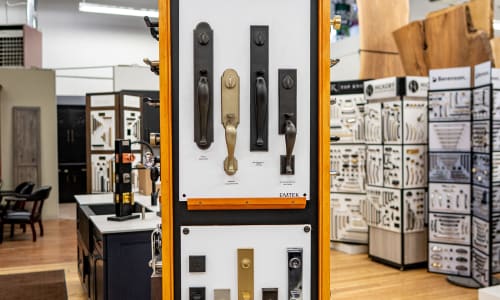
We carry Deltana across all 11 Montana and Idaho stores.


